History & Interviews
[PROJECT INTRODUCTION TO BE PROVIDED]
Research question
What was life really like in the GDR and BRD? Was East Germany a society of constant surveillance and political repression, as depicted in George Orwell’s 1984, or did ordinary people lead fulfilling lives despite political restrictions? What role did the Stasi play in everyday life? Was everyone being watched and monitored? To explore the realities behind Cold War Germany, I traveled to Berlin and interviewed several former East Germans, seeking to understand their personal experiences and uncover the different perspectives behind a divided nation's history.
Introduction & fieldwork
[INTRODUCTORY ESSAY TO BE PROVIDED]
Long-form writing can be added in src/content/.[FIELDWORK OVERVIEW TO BE PROVIDED]
Historical locations
FIELD NOTES / LOCATIONS[HISTORICAL LOCATIONS VISITED TO BE PROVIDED]
For each place: name, date, description, photograph, caption, and source.Interview directory
05 PAGES / 05 INTERVIEWEES[INTERVIEW DIRECTORY INTRODUCTION TO BE PROVIDED]
05 PUBLISHED INTERVIEWEE PROFILESIngolf — Escape from East Germany
A former East German who shared his experiences of life under socialism and his decision to leave the GDR.

Torsten Rexin — Historical Perspectives
An interviewee who explored the GDR's political institutions and the differing interpretations of East German history.
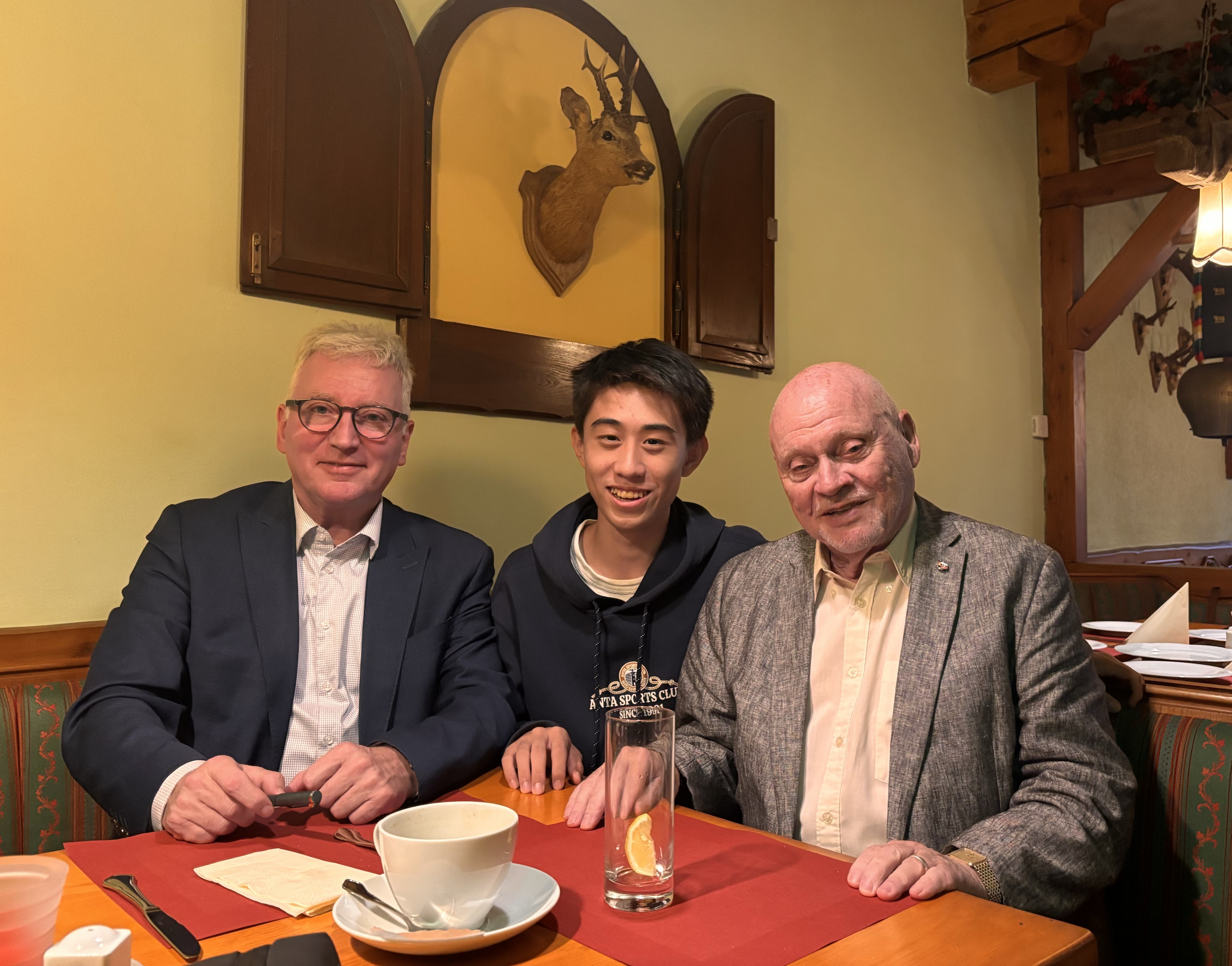
Günther — Political Exile
An aspiring astrophysicist expelled from the GDR in 1982 for his political dissent.

Frank Schumann — Journalist and Publisher
A former GDR journalist who reflected on reunification and the contested historical memory of East Germany.

Hans Bauer — Former GDR Prosecutor
A former Deputy Prosecutor General who discussed and defended aspects of the GDR's political and judicial systems.
Archive & documents
Documents, articles & media
- [1]
Fulbrook, M. (2005). The people’s state: East German society from Hitler to Honecker. Yale University Press.
- [2a]
Oral History Association. (2018). OHA core principles.
Open source ↗ - [2b]
Oral History Association. (n.d.). Oral history best practices.
Open source ↗ - [3]
Deutscher Bundestag. (2013, June 12). 17. Juni 1953: Massenprotest gegen die SED-Führung [June 17, 1953: Mass protest against the SED leadership].
Open source ↗ - [4]
Government of the German Democratic Republic. (1953, June 17). Statement by the Government of the GDR. German History in Documents and Images.
Open source ↗ - [5]
Christlich Demokratische Union Deutschlands. (1953, September 6). Alle Wege des Marxismus führen nach Moskau! Darum CDU [All roads of Marxism lead to Moscow! Therefore, vote CDU] [Poster]. Friedrich-Ebert-Stiftung.
Open source ↗ - [6]
Deutsche Demokratische Republik. (1968, April 9). Verfassung der Deutschen Demokratischen Republik [Constitution of the German Democratic Republic]. Verfassungen.de.
Open source ↗ - [7]
Nationalrat der Nationalen Front des Demokratischen Deutschland. (Ed.). (1965). Braunbuch: Kriegs- und Naziverbrecher in der Bundesrepublik; Staat, Wirtschaft, Armee, Verwaltung, Justiz, Wissenschaft [Brown book: War criminals and Nazi criminals in the Federal Republic; state, economy, army, administration, judiciary, academia]. Staatsverlag der DDR.
Open source ↗ - [8]
Wirtz, S. (2016, February 15). Hans Globke 1898–1973. Lebendiges Museum Online.
Open source ↗ - [9]
Deutscher Bundestag. (1959, January 22). Stenographischer Bericht: 56. Sitzung [Stenographic report: 56th sitting] (3. Wahlperiode, Plenarprotokoll 3/56).
Open source ↗ - [10]
Federal Government of Germany. (1956, June 28). The Hallstein Doctrine. German History in Documents and Images.
Open source ↗ - [11]
Council of Ministers of the German Democratic Republic. (1961, August 12). GDR Council of Ministers’ decision to seal the border. German History in Documents and Images.
Open source ↗ - [12]
Chronik der Mauer. (n.d.). 1. Juli 1968 [July 1, 1968].
Open source ↗ - [13]
Federal Republic of Germany, & German Democratic Republic. (1972, December 21). Treaty on the basis of relations between the Federal Republic of Germany and the German Democratic Republic. German History in Documents and Images.
Open source ↗ - [14]
Lambrecht, H. (1982, October 9). Der innerdeutsche Handel—Ein Güteraustausch im Spannungsfeld von Politik und Wirtschaft [Inter-German trade—An exchange of goods between politics and economics]. Aus Politik und Zeitgeschichte, (B 40/82), 3–17.
Open source ↗ - [15]
Deutsche Demokratische Republik. (1974, October 7). Verfassung der Deutschen Demokratischen Republik [Constitution of the German Democratic Republic]. German History in Documents and Images.
Open source ↗ - [16]
Christlich Demokratische Union Deutschlands, Bundesgeschäftsstelle, Abteilung Öffentlichkeitsarbeit. (1973). Öffentlichkeitsarbeit [Public relations]. Union in Deutschland, (16), 13.
Open source ↗ - [17]
Bundesverfassungsgericht [BVerfG] [Federal Constitutional Court], Judgment of July 31, 1973, 2 BvF 1/73, 36 BVerfGE 1 (Ger.).
Open source ↗ - [18]
Conference on Security and Co-operation in Europe. (1975, August 1). Helsinki Final Act. Organization for Security and Co-operation in Europe.
Open source ↗ - [19]
OSCE Office for Democratic Institutions and Human Rights. (2022). OSCE human dimension commitments: Volume 1, thematic compilation (4th ed.).
Open source ↗ - [20]
Bundesarchiv. (2020, July 22). Der KSZE-Prozess und die DDR-Staatssicherheit [The CSCE process and the GDR state security service] (Episode 12) [Audio podcast episode]. In 111 Kilometer Akten.
Open source ↗ - [21]
For our country. (1989, November 26). German History in Documents and Images.
Open source ↗ - [22]
Deutscher Bundestag. (2025, February 12). Vor 35 Jahren: Erste freie Wahl zur Volkskammer der DDR [35 years ago: The first free election to the GDR People’s Chamber].
Open source ↗ - [23]
Bundesarchiv. (n.d.-a). Geschichte des Stasi-Unterlagen-Archivs [History of the Stasi Records Archive].
Open source ↗ - [24]
Bundesarchiv. (n.d.-b). Was war die Stasi? [What was the Stasi?].
Open source ↗ - [25a]
Deutscher Bundestag. (n.d.). Aufarbeitung von Geschichte und Folgen der SED-Diktatur in Deutschland (1992–1998) [Examining the history and consequences of the SED dictatorship in Germany, 1992–1998].
Open source ↗ - [25b]
Deutscher Bundestag. (2022, March 17). 30 Jahre Enquete-Kommission zur Aufarbeitung der SED-Diktatur [Thirty years since the commission of inquiry into the SED dictatorship].
Open source ↗ - [26a]
Bundesstiftung zur Aufarbeitung der SED-Diktatur. (n.d.). Stiftungsauftrag [The Foundation’s mission].
Open source ↗ - [26b]
Gesetz über die Errichtung einer Stiftung zur Aufarbeitung der SED-Diktatur [Act establishing a foundation for the study of the SED dictatorship], BGBl. I S. 1226–1228 (1998).
- [27]
Stiftung Haus der Geschichte der Bundesrepublik Deutschland. (n.d.). Unsere Geschichte: Diktatur und Demokratie nach 1945 [Our history: Dictatorship and democracy after 1945]. Retrieved September 23, 2026, from
Open source ↗ - [28a]
von Donnersmarck, F. H. (Director). (2006). Das Leben der Anderen [The lives of others] [Film]. Wiedemann & Berg Filmproduktion; Bayerischer Rundfunk; Arte Deutschland TV.
- [28b]
filmportal.de. (n.d.). Das Leben der Anderen.
Open source ↗ - [29a]
Becker, W. (Director). (2003). Good Bye, Lenin! [Film]. X Filme Creative Pool.
- [29b]
X Verleih AG. (n.d.). Good Bye, Lenin!
Open source ↗
Part II. Additional Books and Academic Publications
- [30]
The Burnout Society
Han, B.-C. (2015). The burnout society (E. Butler, Trans.). Stanford University Press.
- [31]
我眼中的改革 — Hans Modrow
Modrow, H. (2012). Reform through my eyes (X. Ma, Z. Yu, & X. Zhao, Trans.). Central Compilation & Translation Press.
- [32]
起点与终点:前东德总理莫德罗回忆录 — Hans Modrow
Modrow, H. (2002). Beginning and end: Memoirs of former East German prime minister Hans Modrow (J. Wang, Trans.). Military Science Press.
- [33]
Germany: Migration, Islam and National Identity
Nordbruch, G. (2011). Germany: Migration, Islam and national identity [Research paper]. Centre for Contemporary Middle East Studies, University of Southern Denmark.
- [34]
包容他者 — Jürgen Habermas
Habermas, J. (2002). The inclusion of the other (W. Cao, Trans.). Shanghai People's Publishing House.
- [35]
A Generation Divided: German Children and the Berlin Wall
Davey, T. A. (1987). A generation divided: German children and the Berlin Wall. Duke University Press.
- [36]
The Guest Worker Question in Postwar Germany
Chin, R. (2007). The guest worker question in postwar Germany. Cambridge University Press.
Reflection — Beyond the Berlin Wall
The history of the German Democratic Republic cannot be reduced to a simple division between political oppression and socialist nostalgia. Even among those who lived under the same political system, personal experiences and historical interpretations differed profoundly.
For some, the GDR represented social security, affordable housing, and a sense of belonging; for others, it was defined by political surveillance, restrictions on individual freedom, and forced separation. These contrasting memories reveal the complexity of everyday life under socialism, where social stability and political repression could coexist without diminishing the significance of either.
German reunification in 1990 brought an end to the division of the state, but not to the division of historical memory. The institutional continuity of the Federal Republic shaped how East German history was publicly represented, particularly through narratives of dictatorship, surveillance, and political victimization. Yet the recollections of former East Germans demonstrate that historical memory remains contested, shaped by individual experiences, political positions, and changing social circumstances.
Understanding history requires more than distinguishing truth from propaganda; it demands an examination of which facts are preserved, whose voices are heard, and how historical narratives acquire authority. Recognizing the complexities of everyday life must not diminish accountability for political repression, just as acknowledging state oppression must not erase the social experiences and personal identities formed within the GDR.
Ultimately, the question is not whether East Germany should be remembered as a state of oppression or a society of belonging, but how these seemingly contradictory realities can be examined together. History is neither a collection of personal memories nor a narrative determined by political victors, but a continuous process of questioning, interpreting, and critically evaluating the past.